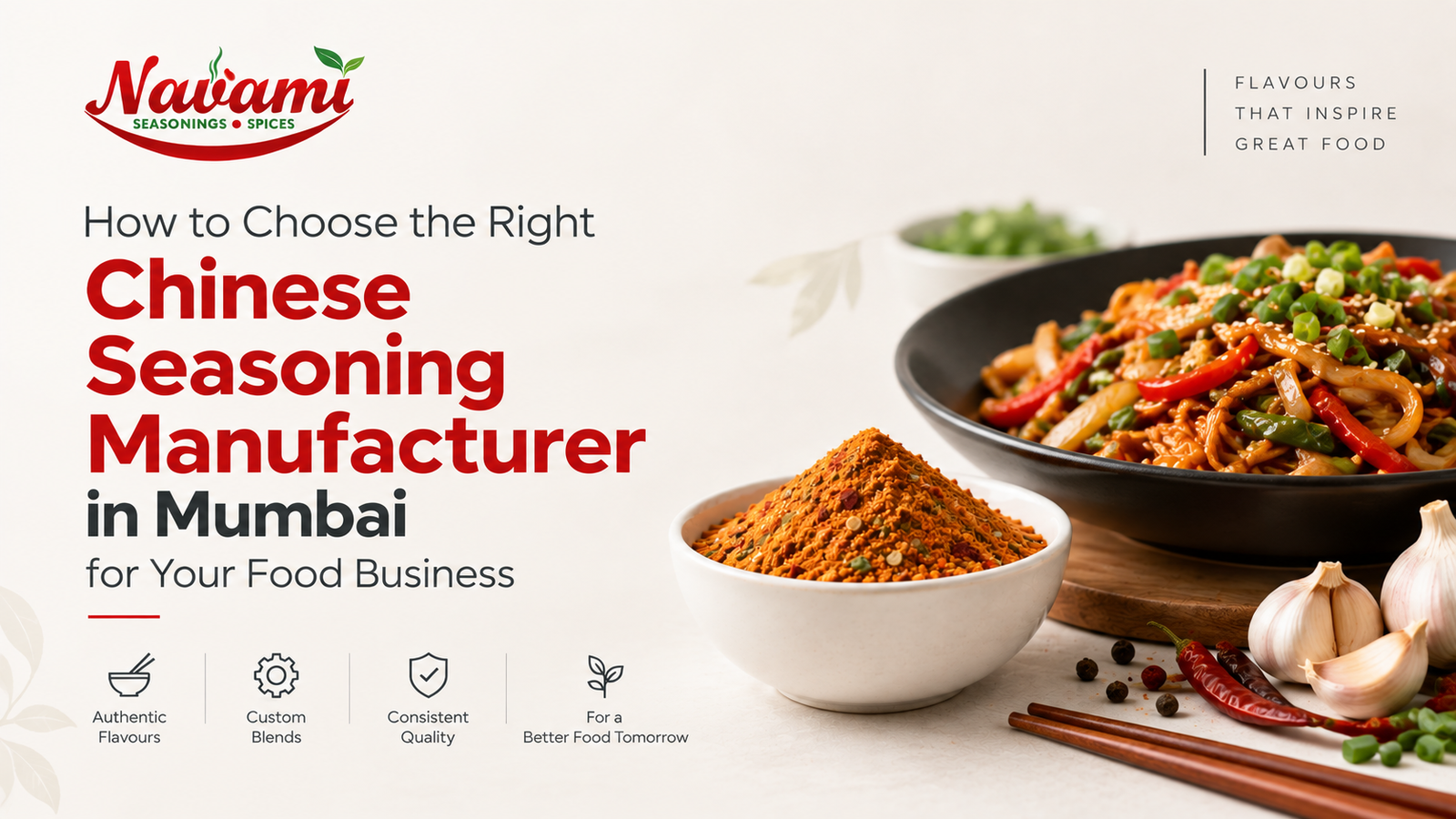
Chinese-inspired flavours have become increasingly popular across snacks, instant foods, noodles, sauces, ready-to-eat products, and modern packaged foods. From spicy Schezwan and Manchurian profiles to garlic, chilli, soy-inspired and stir-fry flavours, the right seasoning can help a food product deliver a distinctive and consistent taste.
For food brands, choosing the right Chinese seasoning manufacturer is therefore an important part of product development. The manufacturer needs to understand not only flavour preferences but also application, seasoning adhesion, dosage, consistency, quality requirements, and commercial production needs.
If you are looking for a Chinese seasoning manufacturer in Mumbai, this guide explains the key factors to consider before selecting a supplier.
What Is a Chinese Seasoning?
Chinese seasoning refers to a blend formulated to provide characteristic Chinese-inspired taste, aroma, and flavour to a food product. Depending on the application, a seasoning may combine spices, herbs, salt, flavouring ingredients, chilli, garlic, onion, and other components.
Chinese seasoning can be developed for different applications, including:
- Potato chips and extruded snacks
- Makhana and popcorn
- Instant noodles
- Noodles and pasta
- Namkeen and savoury snacks
- Ready-to-eat meals
- Sauces and dips
- Frozen food products
- Meat and plant-based products
- Restaurant and food-service products
The formulation can be adjusted depending on whether the seasoning needs to be sprinkled, blended, coated, or incorporated during processing.
Why Choosing the Right Chinese Seasoning Manufacturer Matters
The seasoning contributes directly to the sensory experience of a food product. Two products using similar ingredients can taste completely different depending on the formulation, application, and quality of the seasoning.
A suitable manufacturing partner can help a business achieve:
- Consistent flavour across production batches
- A distinctive flavour profile
- Suitable seasoning adhesion
- Better compatibility with the food application
- Customised formulations
- Reliable bulk supply
- Support during product development
For brands launching a new SKU, selecting the manufacturer early can also make product trials and formulation adjustments easier.
1. Look for Custom Chinese Seasoning Formulation
One of the first things to evaluate is whether the manufacturer offers customised seasoning development.
A standard Chinese seasoning may work for some applications, but food brands often need a specific flavour profile. For example, a snack manufacturer may want a stronger chilli-garlic flavour, while an instant noodle brand may require a more balanced savoury and aromatic profile.
Customisation can involve adjusting:
- Spice intensity
- Chilli heat
- Garlic and onion notes
- Sweet and savoury balance
- Saltiness
- Aroma
- Flavour intensity
- Aftertaste
Working with a manufacturer capable of developing custom blends gives food businesses greater flexibility during product development.
2. Consider the Food Application
The same seasoning formulation may not perform equally well across every food product.
For example, seasoning for potato chips needs to adhere effectively to the surface, while a seasoning for instant noodles may need to disperse differently. Similarly, a blend designed for a dry snack may require different characteristics from one used in a ready-to-eat meal.
Before choosing a Chinese seasoning manufacturer, explain the exact application and production process. This allows the manufacturer to recommend or formulate a blend suited to the product.
3. Evaluate Flavour Consistency
Consistency is critical for packaged food brands.
Consumers expect their favourite snack or ready-to-eat product to deliver a familiar taste every time. Variations in seasoning composition can affect the flavour of the finished product and ultimately impact consumer perception.
Ask the manufacturer about its approach to formulation, raw-material control, production processes, and batch consistency.
A reliable supplier should be able to maintain the desired flavour profile across regular production requirements.
4. Check Quality and Manufacturing Standards
Quality should be a major consideration when selecting any ingredient supplier.
Food businesses should understand how the manufacturer manages raw materials, production, quality checks, packaging, and storage. It is also useful to review available certifications and quality credentials.
You can review the manufacturer's accreditations and quality information before beginning a commercial partnership.
The objective is not simply to find a seasoning that tastes good but to work with a supplier capable of meeting the quality requirements of commercial food production.
5. Ask for Product Samples
Product sampling is an important stage when selecting a Chinese seasoning manufacturer in Mumbai.
Rather than evaluating the seasoning only by tasting it directly, test it on the actual food product. This gives a more realistic understanding of:
- Flavour intensity
- Seasoning adhesion
- Aroma
- Salt and spice balance
- Appearance
- Aftertaste
- Performance after processing
For example, a Chinese seasoning that tastes highly intense on its own may produce the desired flavour after being applied to a snack at the recommended dosage.
Multiple sample iterations may be required before the final blend is approved.
6. Understand Minimum Order Quantities and Pricing
Commercial requirements should be discussed before finalising a supplier.
Ask about minimum order quantities, sample quantities, packaging formats, lead times, and pricing structure. A small food brand launching a new product may have different requirements from an established manufacturer producing large volumes.
The cheapest seasoning is not necessarily the most suitable option if it creates consistency or supply issues. Instead, consider the overall value offered by the manufacturer, including quality, customisation, technical support, and reliability.
7. Check Production and Supply Capacity
As your food product grows, your seasoning requirements may increase.
Therefore, it is useful to understand whether the manufacturer can support your expected production volumes. A supplier that can handle both initial product trials and future commercial requirements can simplify procurement as your business expands.
Discuss expected monthly requirements and potential future volumes in advance.
8. Consider Communication and Product Development Support
Communication becomes particularly important when developing a customised seasoning.
Your manufacturer should be able to understand your desired flavour profile and provide practical feedback during sampling and formulation.
For example, you may describe the requirement as:
- Spicy Chinese flavour
- Strong garlic and chilli notes
- Mild Schezwan profile
- Smoky stir-fry flavour
- Sweet and spicy Chinese profile
Clear communication helps the formulation team understand the desired sensory direction and make appropriate adjustments.
Businesses can also learn more about the manufacturer through its company information before starting discussions.
Popular Chinese Seasoning Profiles for Food Products
Chinese-inspired seasoning can be developed across a wide range of flavour profiles.
Schezwan Seasoning
Schezwan-inspired seasoning combines spicy, savoury, and aromatic characteristics and can be used for snacks, noodles, fries, and other products.
Chinese Garlic Seasoning
Garlic-forward seasoning can provide a strong savoury and aromatic profile for snacks, noodles, sauces, and ready-to-eat products.
Manchurian Seasoning
Manchurian-inspired blends can provide a familiar sweet, spicy, savoury, and aromatic profile suitable for different food applications.
Chilli Garlic Seasoning
Chilli garlic profiles combine heat with the distinctive flavour of garlic and can work across snack and processed food categories.
Custom Chinese Spice Blends
Food businesses can also develop completely customised Chinese-inspired blends based on their target audience, product positioning, and desired taste profile.
Why Work With a Chinese Seasoning Manufacturer in Mumbai?
Mumbai is an important commercial and food-processing market, with businesses across food manufacturing, snacks, restaurants, distribution, and packaged foods.
For businesses based in Mumbai and surrounding areas, working with a local seasoning manufacturer can make communication, sampling, product trials, and supply coordination more convenient.
A manufacturer familiar with commercial food requirements can also provide seasoning solutions designed around specific applications rather than offering only generic spice blends.
Questions to Ask Before Choosing a Manufacturer
Before placing a commercial order, ask the manufacturer:
- Can you develop a customised Chinese seasoning?
- Is the seasoning suitable for my specific food application?
- Can I receive product samples before placing an order?
- What are the minimum order quantities?
- What quality certifications are available?
- What is the expected production and delivery timeline?
- Can you support larger quantities as my business grows?
- Can the formulation be adjusted after product trials?
Getting clear answers to these questions can help reduce uncertainty during supplier selection.
Choose a Chinese Seasoning Partner for Your Food Product
The right Chinese seasoning can help a food brand create a recognisable flavour profile and maintain consistency across production. However, selecting a manufacturer requires more than simply comparing flavour options or prices.
Look at customisation capabilities, application suitability, quality standards, sample development, production capacity, pricing, and long-term supply support before making a decision.
For food businesses searching for a Chinese seasoning manufacturer in Mumbai, the right manufacturing partner can support everything from initial flavour development to commercial-scale seasoning requirements.
If you are developing a new snack, noodle, ready-to-eat product, or other food application, contact the seasoning team to discuss your flavour requirements and explore suitable seasoning solutions.
Frequently Asked Questions
1. What products can use Chinese seasoning?
Chinese seasoning can be used in potato chips, extruded snacks, makhana, popcorn, noodles, pasta, namkeen, ready-to-eat foods, sauces, frozen foods, and other savoury products. The formulation can be adjusted according to the specific application.
2. Can a Chinese seasoning manufacturer create a custom flavour?
Yes. Manufacturers with formulation capabilities can develop customised Chinese-inspired seasoning blends based on factors such as spice intensity, garlic, chilli, savoury notes, aroma, dosage, and the requirements of the finished food product.
3. How should I select a Chinese seasoning manufacturer in Mumbai?
Compare manufacturers based on customisation capabilities, product quality, application expertise, sample development, certifications, minimum order quantities, production capacity, pricing, and supply reliability. Testing samples on the actual food product is also an important step before commercialising the seasoning.