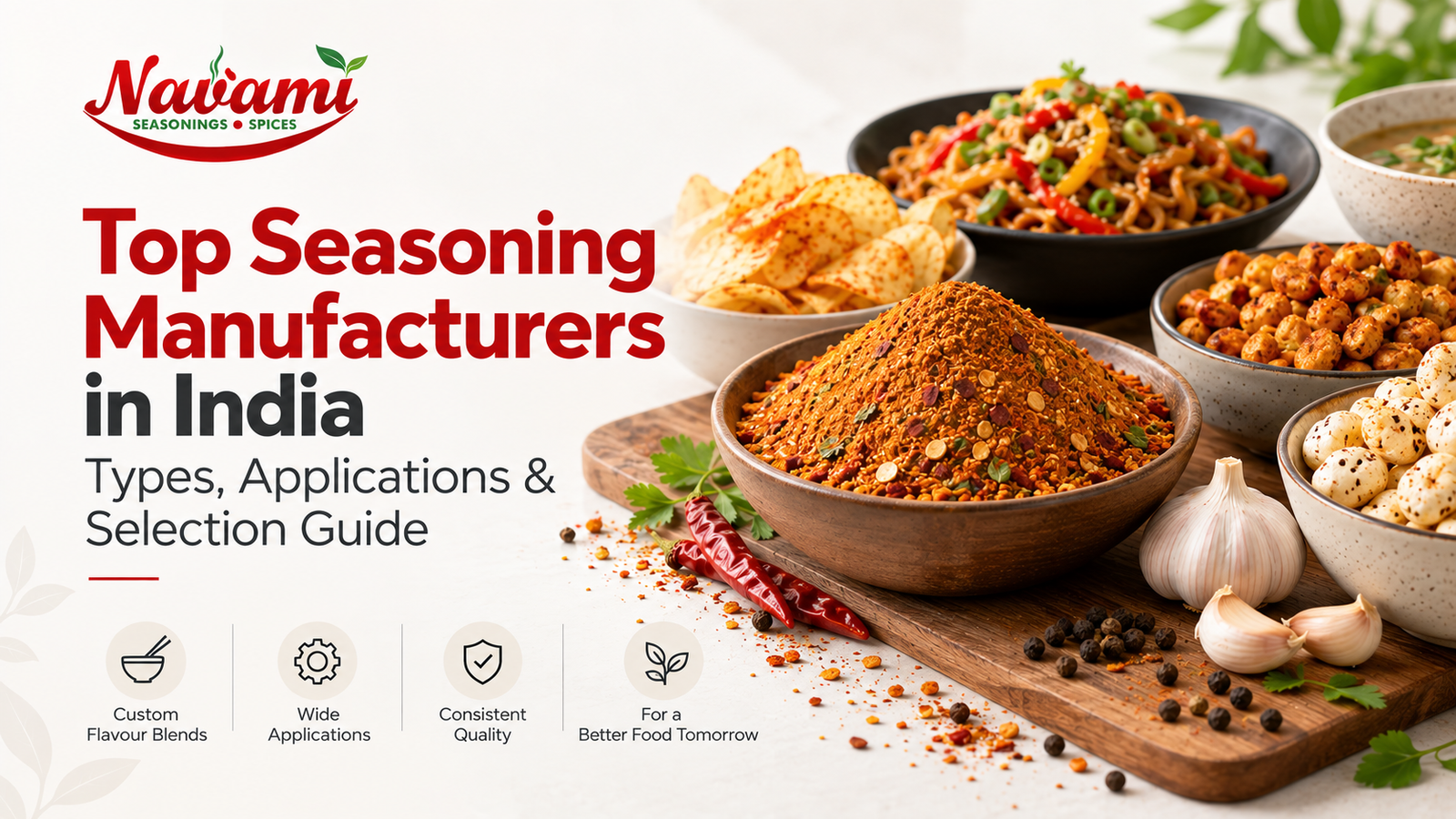
The flavour of a food product can influence everything from first impressions to repeat purchases. Whether it is a packet of potato chips, a bowl of makhana, a serving of popcorn, instant noodles, or a ready-to-eat meal, seasoning plays an important role in creating the desired taste and aroma.
As India's packaged food and snack industry continues to expand, food manufacturers are looking for seasoning partners that can provide consistent, application-specific and customised flavour solutions. This has increased the importance of choosing the right seasoning manufacturer rather than simply purchasing standard spice blends.
For businesses researching the top seasoning manufacturers in India, the selection process should consider formulation expertise, product applications, quality standards, customisation, production capacity, sampling, and long-term supply reliability.
This guide explains the major types of food seasonings, where they are used, and what food businesses should consider when selecting a seasoning manufacturing partner.
What Do Seasoning Manufacturers in India Do?
Seasoning manufacturers formulate and produce blends designed to enhance the taste, aroma, appearance, and overall sensory experience of food products.
A seasoning can contain a combination of spices, herbs, salt, flavouring ingredients and other food-grade components. The exact formulation depends on the intended application and the desired flavour profile.
Professional manufacturers may provide standard as well as customised seasoning solutions for:
- Potato chips
- Fried and extruded snacks
- Baked snacks
- Makhana
- Nuts
- Popcorn
- Namkeen
- Instant foods
- Ready-to-eat products
- Frozen foods
- Noodles and pasta
- International food applications
For food businesses, working with a manufacturer that understands the final application is important because a seasoning needs to perform properly on the finished product, not just taste good on its own.
Why Food Businesses Need the Right Seasoning Manufacturer
A food manufacturer could source individual spices and create its own blend, but commercial seasoning development involves several technical considerations.
The formulation may need to account for dosage, coating, adhesion, moisture, processing conditions, flavour intensity, aroma, and batch-to-batch consistency.
An experienced seasoning manufacturer can support food businesses with:
- Custom flavour development
- Application-specific formulations
- Product sampling
- Consistent batch production
- Bulk seasoning supply
- Flavour profile adjustments
- New product development
- Commercial-scale production
For a brand launching a new SKU, these capabilities can make the product development process more structured and efficient.
Types of Food Seasonings Used by Manufacturers
Different food products require different seasoning profiles. Some of the most common categories include the following.
Potato Chip Seasoning
Potato chips are one of the most popular applications for dry seasoning blends. Flavours can range from classic masala and tomato to cheese, peri-peri, barbecue, chilli, sour cream and onion, and customised profiles.
For chips, the seasoning needs to distribute evenly and adhere effectively to the surface while delivering the intended flavour at the recommended dosage.
Businesses looking for application-specific solutions can explore potato chip seasoning for commercial snack production.
Fried and Extruded Snack Seasoning
Fried and extruded snacks can have different surface characteristics depending on the production process and base ingredients.
Seasoning blends for these products can include cheese, masala, chilli, tomato, barbecue, peri-peri and other flavour profiles.
For brands producing these products at scale, formulation needs to consider coating, flavour intensity and consistency. Fried and extruded snack seasoning can be developed according to the requirements of the finished snack.
Baked Snack Seasoning
Baked snacks are another growing application for seasoning manufacturers. Crackers, baked extruded snacks and other products can be paired with savoury, spicy, cheesy, herby or tangy profiles.
Since baked products can have different surface properties from fried snacks, the seasoning formulation and application method may need to be adjusted accordingly.
Explore baked and extruded snack seasoning for food products requiring customised flavour solutions.
Makhana Seasoning
Makhana has become a popular snack format, particularly among consumers looking for convenient alternatives to traditional snacks.
Brands can use a range of seasoning profiles, including peri-peri, cheese, mint, chilli lime, tomato, masala and other customised flavours.
For businesses developing flavoured makhana products, makhana seasoning can be formulated around the desired taste and application.
Nuts Seasoning
Flavoured nuts can be developed using spicy, tangy, smoky, savoury, herb-based and other seasoning profiles.
The seasoning needs to complement the natural taste of the nut while providing sufficient flavour coverage.
Food businesses can explore nuts seasoning solutions when developing commercial flavoured nut products.
Popcorn Seasoning
Popcorn offers opportunities for both classic and innovative flavour combinations. Cheese, butter-style, chilli, peri-peri, barbecue and other savoury profiles can be developed depending on the product concept.
Popcorn seasoning can be formulated according to the desired flavour intensity and application.
International Flavour Seasonings
Consumer interest in global cuisines has also created opportunities for food brands to introduce international flavour profiles.
Seasoning manufacturers can develop blends inspired by cuisines such as:
- Chinese
- Italian
- Mexican
- Mediterranean
- Korean-inspired flavours
- American barbecue
- Peri-peri
These flavours can be applied to snacks, noodles, ready-to-eat foods, sauces and other processed food categories.
Businesses developing global flavour products can explore international flavour solutions for different food applications.
Custom Seasoning Development for Food Brands
Not every food business wants a standard seasoning blend.
A brand may have a particular flavour profile in mind that needs to be adjusted according to its product, target market and positioning. In such cases, custom formulation becomes important.
A typical development process may involve:
- Understanding the food product
- Defining the desired flavour
- Selecting suitable ingredients
- Preparing an initial formulation
- Testing the seasoning on the actual food
- Adjusting flavour intensity and balance
- Approving the final sample
- Scaling the formulation for production
For example, a snack company may want a spicy and tangy seasoning with a strong chilli note, while another brand may want a milder, more aromatic profile.
Customisation allows manufacturers to work towards these different requirements.
Soup Premixes and Other Food Applications
Seasoning expertise is not limited to dry snack products. Flavour systems are also used in convenience foods and food-service applications.
Soup premixes, instant foods, ready-to-eat products and other categories require formulations that deliver consistent flavour after preparation.
Businesses developing these products can explore soup premixes as part of their wider food product development requirements.
What to Look for in the Top Seasoning Manufacturers in India
There is no single manufacturer that will be the right fit for every food business. The appropriate supplier depends on your application, volume, formulation requirements and commercial objectives.
However, several factors should be evaluated before selecting a manufacturer.
1. Formulation and R&D Capabilities
A manufacturer should be able to understand the desired flavour and modify the blend according to your product requirements.
Ask whether the company offers:
- Custom formulations
- Sample development
- Product trials
- Flavour modifications
- Application-specific solutions
This becomes particularly important when launching a new product.
2. Quality Standards
Seasoning ingredients directly affect the finished food product, so quality management should be a key consideration.
Food businesses should understand the manufacturer's quality processes and review relevant certifications and accreditations.
You can review accreditations and quality information before evaluating a potential seasoning supplier.
3. Batch-to-Batch Consistency
Consistency is critical for FMCG and packaged food brands.
If the same product tastes noticeably different between batches, it can affect the consumer experience. A suitable manufacturer should have processes in place to maintain the intended formulation and flavour profile across production batches.
4. Application Expertise
A manufacturer should understand the specific food application.
Seasoning for potato chips, for example, may have different requirements from seasoning used for noodles, popcorn, makhana or ready-to-eat meals.
When contacting a supplier, provide details about the product, processing method and expected application.
5. Sampling and Product Trials
Never rely solely on a written flavour description when selecting a seasoning.
Request samples and test them on the actual food product.
Evaluate:
- Flavour intensity
- Aroma
- Coating
- Taste balance
- Aftertaste
- Appearance
- Performance after processing
The final seasoning should be evaluated at the intended application dosage rather than only as a dry powder.
6. Production Capacity
Your seasoning requirements may change as your food business grows.
A supplier should ideally be able to support the transition from product trials to commercial production.
Before finalising a manufacturer, discuss:
- Minimum order quantities
- Monthly production capacity
- Packaging options
- Lead times
- Repeat-order timelines
- Future volume requirements
This can help prevent supply problems when demand increases.
Why Mumbai Is an Important Market for Seasoning Manufacturing
Mumbai is a major commercial centre with a broad ecosystem of food businesses, FMCG companies, snack manufacturers, distributors and food-processing operations.
For businesses located in Mumbai, Thane, Navi Mumbai and surrounding industrial areas, working with an accessible seasoning manufacturer can simplify communication, sampling, product development and supply coordination.
Navami Flavours provides seasoning and flavour solutions for food businesses across multiple applications. Businesses can learn more about the company through its about page.
How to Compare Seasoning Manufacturers
Before selecting a supplier, food businesses should create a comparison based on their actual requirements rather than simply comparing product prices.
Consider these factors:
| Factor | What to Check |
|---|---|
| Customisation | Can the blend be modified? |
| Application | Does the manufacturer understand your food product? |
| Quality | What quality systems and certifications are available? |
| Sampling | Can you test samples before bulk production? |
| Consistency | How is batch consistency maintained? |
| Capacity | Can the supplier handle future volumes? |
| MOQ | Is the minimum order suitable for your business? |
| Lead Time | Can production timelines match your requirements? |
| Support | Is there assistance during product development? |
This approach can help procurement and R&D teams make a more informed supplier decision.
Questions to Ask a Seasoning Manufacturer Before Ordering
Before placing a commercial order, ask the manufacturer:
- Can you develop a custom seasoning for my product?
- What applications do you specialise in?
- Can I receive samples for product testing?
- What is the recommended dosage?
- What quality certifications are available?
- What is the minimum order quantity?
- What is the expected production lead time?
- Can you support larger volumes in the future?
- Can the seasoning be modified after trials?
- What packaging options are available?
Getting these details early can make supplier evaluation easier and reduce potential production issues.
Choosing a Long-Term Seasoning Partner
Selecting from the top seasoning manufacturers in India should involve more than looking at the number of products a company offers.
The right supplier should be able to understand your application, develop or customise the desired flavour, maintain consistency, meet quality requirements and support your production volumes.
Whether you are launching potato chips, makhana, popcorn, nuts, extruded snacks, noodles, ready-to-eat foods or another processed food product, seasoning should be treated as an important part of product development rather than simply another raw material.
For businesses looking for customised seasoning and flavour solutions, explore Navami Flavours' seasoning solutions and discuss your specific product requirements with the team.
If you are ready to discuss samples, formulations or commercial requirements, contact Navami Flavours to explore suitable seasoning solutions for your food business.
Frequently Asked Questions
1. What types of seasoning do manufacturers in India produce?
Seasoning manufacturers produce a wide range of blends for chips, fried and extruded snacks, baked snacks, makhana, nuts, popcorn, namkeen, noodles, instant foods, ready-to-eat products and other food applications. Both standard and customised flavour profiles can be developed depending on the manufacturer's capabilities.
2. Can seasoning manufacturers develop custom blends?
Yes. Manufacturers with formulation and R&D capabilities can develop custom seasoning blends according to the food application and desired flavour profile. The process generally involves sample development, product testing, formulation adjustments and final approval before commercial production.
3. How do I choose the right seasoning manufacturer in India?
Compare manufacturers based on formulation expertise, application knowledge, quality standards, sample development, production capacity, batch consistency, minimum order quantities, lead times and supply reliability. Testing the seasoning on your actual food product before placing a bulk order is also recommended.